








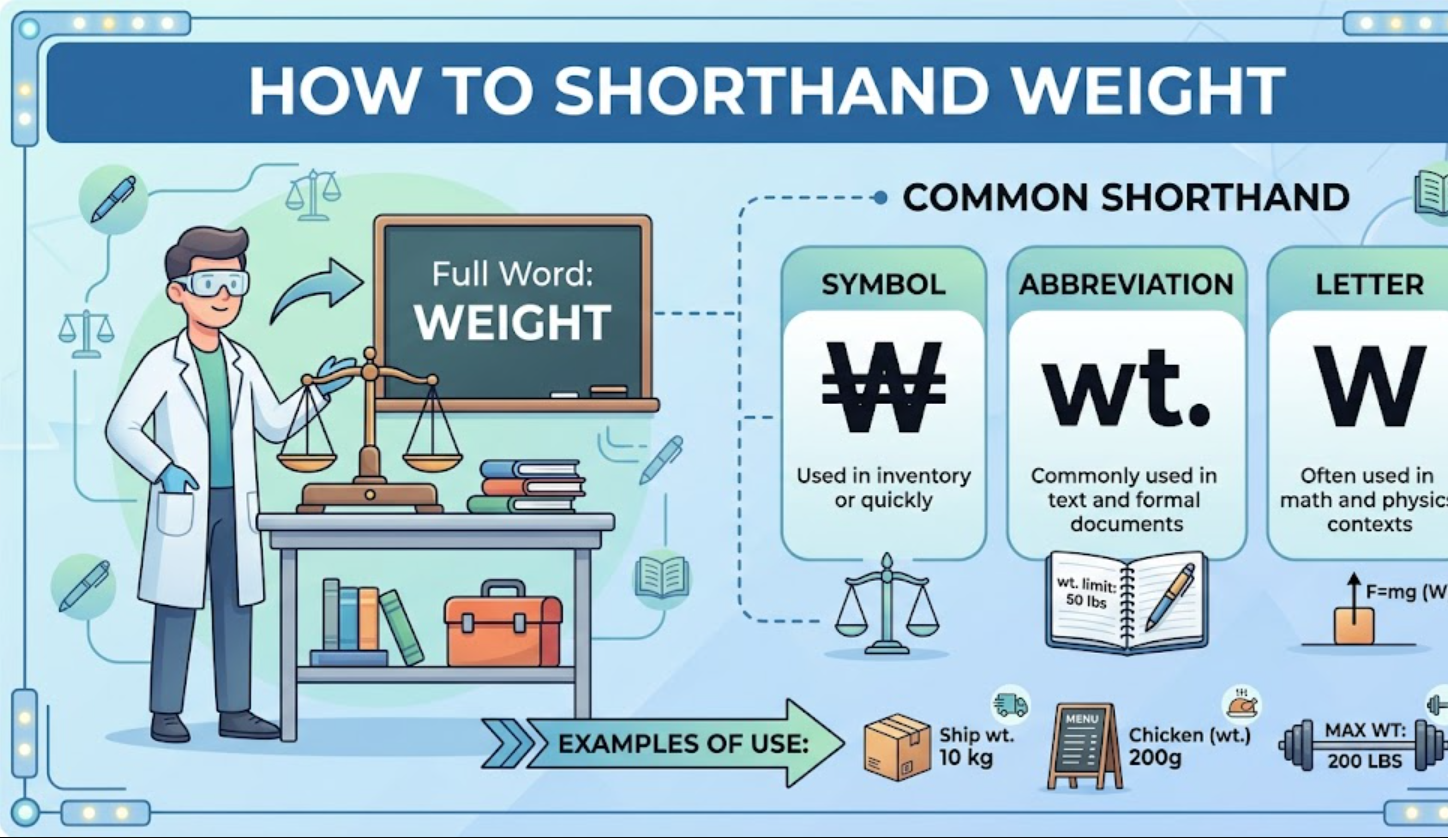
Understanding how to shorthand weight is an essential skill for students, professionals, and anyone who frequently records measurements. Whether you are writing notes in a classroom, managing inventory, documenting fitness progress, or working in science and healthcare, using shorthand for weight helps save time, improve clarity, and maintain consistency.
In today’s fast-paced world, efficiency matters. Writing full words like “kilograms” or “pounds” repeatedly can slow you down, especially when dealing with large amounts of data. This is where shorthand weight notation becomes incredibly useful. It allows you to communicate precise information quickly while maintaining accuracy and readability.
This comprehensive guide explores everything you need to know about shorthand weight, including common abbreviations, practical examples, professional usage, and best practices. By the end, you will have a clear understanding of how to apply shorthand weight in different contexts with confidence.
What Does Shorthand Weight Mean?
Shorthand weight refers to the use of abbreviated symbols or shortened forms to represent units of weight instead of writing them in full. These abbreviations are standardized in most cases, ensuring that they are universally understood across different fields and industries.
For example, instead of writing “grams,” you simply write “g.” Similarly, “kilograms” becomes “kg,” and “pounds” becomes “lb.” These shortened forms are widely accepted and used in academic, professional, and everyday writing.
Learning how to shorthand weight is not just about memorizing symbols. It is about understanding when and where to use them appropriately so that your writing remains both efficient and professional.
Why Learning Shorthand Weight Is Important


Using shorthand for weight provides several advantages. It enhances speed, improves organization, and reduces repetition in writing. This is particularly useful in situations where accuracy and efficiency are critical.
In academic settings, shorthand weight helps students take quick notes during lectures. In scientific research, it ensures precision when recording measurements. In business environments such as logistics and retail, shorthand notation allows for streamlined documentation and communication.
Another important benefit is consistency. When everyone uses the same abbreviations, it reduces confusion and ensures that information is interpreted correctly.
Common Units Used in Shorthand Weight
To fully understand how to shorthand weight, it is essential to become familiar with the most commonly used units and their abbreviations. These units fall into two main systems: the metric system and the imperial system.
Metric System Abbreviations
The metric system is widely used around the world, especially in scientific and academic contexts. It is based on powers of ten, making it simple and logical.
Also Read: R Not Connecting to Internet Ubuntu Complete Troubleshooting Guide
Gram is written as g, kilogram as kg, milligram as mg, and tonne as t. These abbreviations are standard and should always be written in lowercase, except for special cases defined by scientific conventions.
For example, writing “50 kg” is correct, while writing “50 kilograms” repeatedly in notes can be inefficient.
Imperial System Abbreviations
Countries like the United States commonly use the imperial system. It includes units such as pounds and ounces.
Countries like the United States commonly use the imperial system.
People abbreviate pound as “lb” and ounce as “oz.” These abbreviations come from historical terms and may not always match the spelling of the full word, which is why they are important to memorize.
For instance, “150 lb” is a standard shorthand representation of weight in many fitness or medical records.
How to Shorthand Weight in Everyday Writing
Applying shorthand weight in daily life is easier than it may seem. The key is to use abbreviations consistently and correctly.
When writing measurements, always place the number before the unit abbreviation. For example, write “10 kg” instead of “kg 10.” This format ensures clarity and aligns with global standards.
Spacing is also important. There should be a space between the number and the unit, such as “25 g” rather than “25g,” especially in formal writing.
In informal contexts like quick notes or personal reminders, some people may skip the space, but it is always better to follow proper formatting when accuracy matters.
Examples of Shorthand Weight in Real Life
Understanding how to shorthand weight becomes much easier when you see practical examples. These examples demonstrate how shorthand is used in different situations.
In a grocery list, you might write “2 kg rice” instead of “2 kilograms of rice.” In a fitness journal, you could record “70 kg body weight” to track progress. In a laboratory setting, measurements like “5 mg sample” are standard.
In shipping and logistics, shorthand is essential.Workers label packages with weights such as “15 lb” or “20 kg,” ensuring quick identification and processing.
These examples highlight how shorthand weight improves efficiency across various fields.
Best Practices for Using Shorthand Weight
To use shorthand weight effectively, it is important to follow certain best practices. These practices ensure that your writing remains professional and easy to understand.
Consistency is key. Always use the same unit and abbreviation throughout your document. Switching between different units can confuse readers and lead to errors.
Clarity should always come first. If you are writing for an audience that may not be familiar with certain abbreviations, consider defining them at the beginning.
Accuracy is also crucial. Double-check your measurements and ensure that you are using the correct unit for the context. For example, using milligrams instead of grams can significantly change the meaning of a measurement.
Common Mistakes to Avoid
While learning how to shorthand weight, many people make simple mistakes that can lead to confusion.
One common mistake is using incorrect abbreviations. For example, you should avoid writing “kgs” instead of the standard “kg.”
Also Read: BodenXT Driving Sustainable Industrial Transformation
Another mistake is mixing units without proper conversion. For instance, combining kilograms and pounds in the same context without clarification can create misunderstandings.
Improper formatting is also a frequent issue. Writing “50kg” without a space may be acceptable in informal notes, but it is not recommended in formal writing.
Avoiding these mistakes will help you use shorthand weight more effectively and professionally.
How Shorthand Weight Is Used in Different Fields
Shorthand weight applies across many areas. It is used across multiple industries, each with its own specific requirements.
Healthcare professionals record weight using precise shorthand to monitor patient health. In science, accurate measurement notation is critical for experiments and research. Fitness professionals and athletes use shorthand to track body weight and performance metrics.
In business and logistics, shorthand weight ensures smooth operations by simplifying documentation and communication. These examples show how versatile and important shorthand weight is in modern life.
Tips to Master Shorthand Weight Quickly
Mastering shorthand weight does not take long if you practice regularly and apply it in real situations.
Start by memorizing the most common abbreviations such as g, kg, lb, and oz. Use them consistently in your notes and daily writing.
Practice converting full terms into shorthand. For example, write “100 grams” as “100 g” until it becomes second nature.
Pay attention to formatting and spacing, as these small details make a big difference in clarity and professionalism.
Over time, using shorthand weight will become automatic, saving you time and effort.
The Role of Shorthand Weight in Digital Communication
n the digital age, shorthand weight plays an even more important role. People use abbreviated units from spreadsheets to mobile apps to display information efficiently.
Online shopping platforms use shorthand to show product weights. Fitness apps track body weight using standard abbreviations. Even social media posts often include shorthand for quick communication.
As digital communication continues to grow, understanding how to shorthand weight becomes increasingly valuable.
Conclusion
Learning how to shorthand weight is a simple yet powerful skill that can improve your writing, enhance efficiency, and ensure clarity in communication. By understanding common abbreviations, following best practices, and applying shorthand consistently, you can save time while maintaining accuracy.
Also Read: BodenXT Driving Sustainable Industrial Transformation
Whether you are a student, professional, or everyday user, mastering shorthand weight will help you communicate measurements more effectively. With regular practice, it becomes second nature, allowing you to focus on the content rather than the format.
FAQs
What is the most common shorthand for weight?
The most common shorthand includes g for grams, kg for kilograms, lb for pounds, and oz for ounces.
Is it necessary to leave a space between the number and unit?
Use a space in formal writing, such as “50 kg,” to maintain clarity and proper formatting
Can shorthand weight be used in exams?
Yes, as long as the abbreviations are standard and clearly understood, shorthand weight is acceptable in most academic settings.
How can I avoid mistakes in shorthand weight?
Focus on consistency, use standard abbreviations, and double-check your measurements to ensure accuracy.
Why is shorthand weight important in professional settings?
It improves efficiency, reduces repetition, and ensures clear communication, especially in fields like science, healthcare, and logistics.
For more updates visits: OPEN POSTS


