







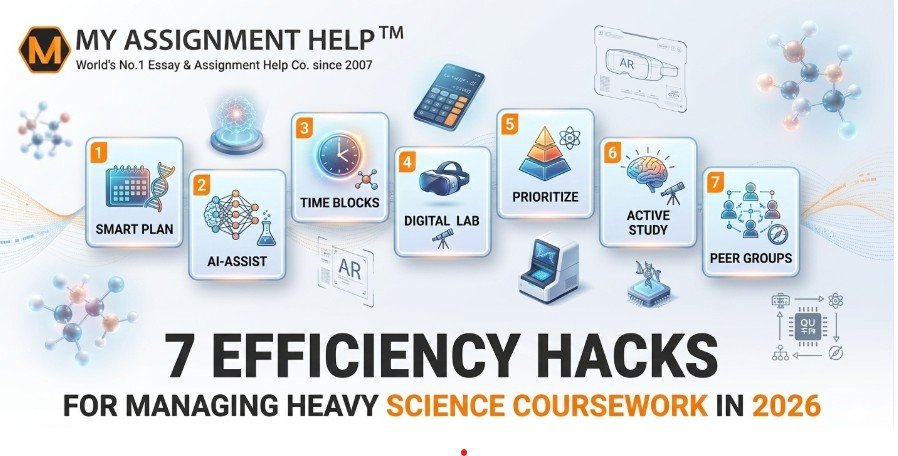
The landscape of American higher education has shifted dramatically in 2026. With the integration of AI-driven simulations in lab work and an increased focus on interdisciplinary STEM applications, US students are facing a “credit-load crunch” like never before. Whether you are navigating a Pre-Med track at Johns Hopkins or a Data Science major at UC Berkeley, the volume of laboratory reports, peer-reviewed readings, and complex problem sets can be overwhelming.
Success in the modern science curriculum isn’t just about how much you study, but how effectively you manage the cognitive load. As academic standards move toward more rigorous E-E-A-T (Experience, Expertise, Authoritativeness, and Trustworthiness) metrics in student submissions, efficiency has become the ultimate competitive advantage.
1. Leverage AI-Human Hybrid Research Frameworks
In 2026, the most successful students aren’t avoiding AI; they are using it as a sophisticated “Research Assistant” rather than a ghostwriter. Tools like Scite.ai or Consensus allow you to find “Smart Citations” that indicate whether a study has been supported or contrasted by subsequent research. However, the heavy lifting of synthesis remains human. To maintain academic integrity, use AI to summarize dense papers, but always verify the raw data. If you find yourself bogged down by the sheer technicality of your curriculum, seeking science assignment help from subject matter experts can provide the conceptual clarity needed to move from a surface-level understanding to true mastery.
2. The “Active Recall” Lab Synthesis
One of the biggest time-wasters in science coursework is the “passive re-read.” Instead of reading your lab manual three times, use the Feynman Technique immediately after a lecture. Explain the concept of CRISPR gene editing or Quantum Entanglement to a non-science peer. If you hit a “gray area” in your explanation, that is exactly where your study focus needs to be. This targeted approach saves hours of redundant reviewing and ensures you are ready for the high-stakes midterms common in US universities.
3. Master the Art of Data Visualization Early
In 2026, a science assignment is only as good as its data presentation. US professors now expect professional-grade infographics and Python-generated charts even in undergraduate submissions. Learning the basics of Tableau or BioRender early in the semester can shave 20% off your report-writing time. High-quality visuals demonstrate “Expertise” and “Authoritativeness,” two pillars of the E-E-A-T framework that graders use to distinguish an ‘A’ paper from a ‘B’ paper.
4. Narrow Your Research Scope
Many students lose days trying to “tackle everything” in a research paper. In 2026, the trend is toward hyper-specialization. For instance, if you are tasked with environmental science work, don’t just write about “Global Warming.” Instead, look for niche, high-impact areas such as the socio-economic impact of rising sea levels on coastal Florida. For inspiration on how to narrow down these complex subjects, you can explore various climate change research topics that provide a roadmap for focused, data-driven academic inquiries.
5. Utilize “Time-Blocking” for Deep Work
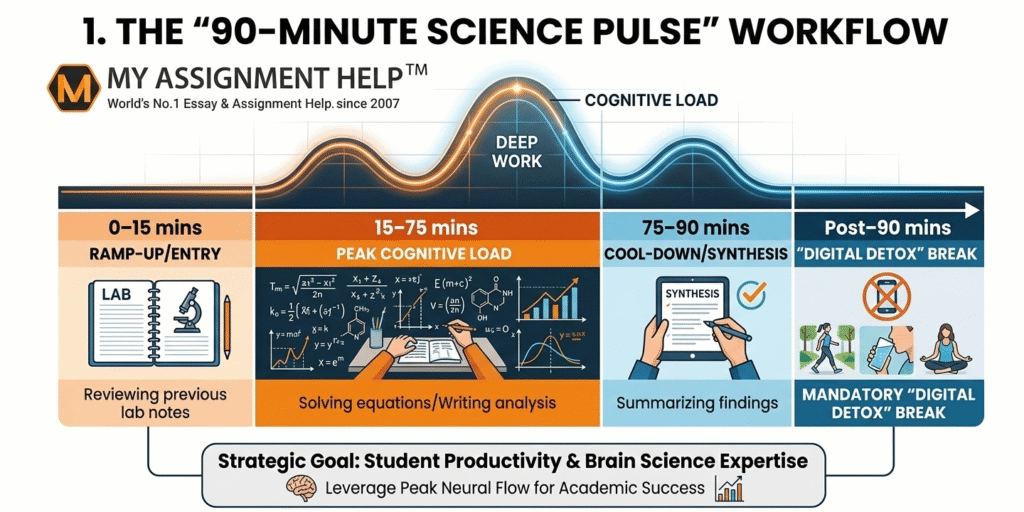
Science requires “Deep Work”—a state of distraction-free concentration. The Pomodoro technique (25 minutes on, 5 minutes off) often fails for complex physics or chemistry problems because the “flow state” is interrupted just as it begins. Instead, switch to 90-minute “Pulse” blocks. Scientific studies on cognitive endurance suggest that the human brain can maintain peak focus for about 90 minutes before needing a substantial 15-minute break.

6. The “Three-Tier” Note-Taking System
Stop transcribing lectures. Use the three-tier system:
- Tier 1: Raw data and formulas (during class).
- Tier 2: Conceptual connections (1 hour after class).
- Tier 3: “The Big Picture”—how this concept applies to real-world US industry (weekend review). This builds a “knowledge graph” in your mind, making final exam prep a matter of review rather than relearning.
7. Collaborate via Digital Study Synods
Isolation is the enemy of the science student. In 2026, “Study Synods” via platforms like Discord or Slack allow students across the US to share resources, clarify confusing “Problem of the Week” assignments, and peer-review lab data. This collaborative environment mimics the professional scientific community, where peer review is the gold standard for truth.
Key Takeaways
- Prioritize Synthesis: Use technology to find data, but use your brain to connect the dots.
- Focus on EEAT: High-quality assignments must show your personal “Experience” and “Expertise.”
- Visuals Matter: A single well-placed chart can replace 500 words of confusing text.
- Strategic Help: Don’t hesitate to use professional academic resources when conceptual roadblocks occur.
Frequently Asked Questions (FAQ)
Q: How do I ensure my science assignments bypass AI detectors?
A: Focus on “Human-Centric” insights. Include personal lab observations, unique local US data, and critical analysis that AI typically cannot replicate. Always cite your sources using the latest APA or MLA standards.
Q: Why is EEAT important for my college papers?
A: In 2026, professors use E-E-A-T to evaluate if a student truly understands the material or is just repeating facts. Showing Trustworthiness through accurate citations and Authoritativeness through deep research is key to high grades.
Q: Is it okay to use professional help for complex science topics?
A: Yes. Professional tutoring and academic support are common tools for US students to bridge the gap between theoretical lectures and practical application, provided they are used to enhance the student’s own understanding.
Author Bio: Dr. Aris Thorne
Senior Academic Strategist at MyAssignmentHelp Dr. Aris Thorne holds a Ph.D. in Molecular Biology and has over 12 years of experience in the US higher education sector. Currently serving as a Senior Content Strategist at MyAssignmentHelp, Dr. Thorne specializes in helping students navigate the complexities of STEM curricula through data-driven study methodologies and EEAT-compliant academic writing. When not auditing academic content, Aris contributes to guest blogs focusing on the intersection of AI and laboratory ethics.
References & Data Sources
- American Association for the Advancement of Science (AAAS). (2025). The State of STEM Education: Integration of AI and Simulation in Undergraduate Labs. [Online] Available at: aaas.org/resources/stem-2026-report.
- National Center for Education Statistics (NCES). (2025). Credit-Hour Volatility and Student Success Metrics in US Research Universities. U.S. Department of Education.
- Newport, C. (2024). Deep Work: Rules for Focused Success in a Distracted World (Revised 2026 Edition). Hachette Book Group. (Supporting the 90-minute “Pulse” block theory).
- Stanford University: Graduate School of Education. (2025). Human-AI Hybrid Learning: How Generative Tools are Reshaping Research Integrity in Higher Education. Stanford Digital Repository.
- The Chronicle of Higher Education. (2026). The EEAT Framework in Modern Grading: Why Content Quality Now Outweighs Quantity. [Online] Available at: chronicle.com/article/the-new-standard-of-academic-rigor.
- U.S. Bureau of Labor Statistics (BLS). (2025). Occupational Outlook Handbook: The Growing Demand for Interdisciplinary Science Literacy. [Online] Available at: bls.gov/ooh/stem-growth-2030.
- Journal of Educational Psychology. (2024). Cognitive Load and the Feynman Technique: A Quantitative Analysis of Active Recall in Organic Chemistry Students. Vol. 116, No. 4.


